
Before You Bet, Read This Morocco Breakdown
The Morocco national football team is the senior men’s side representing Morocco in international football, governed by the Royal Moroccan Football Federation and competing through CAF in Africa. Its....
Before You Bet, Read This Morocco Breakdown
The Morocco national football team is the senior men’s side representing Morocco in international football, governed by the Royal Moroccan Football Federation and competing through CAF in Africa. Its most important modern achievement is a historic fourth-place finish at the 2022 FIFA World Cup in Qatar, where Morocco became the first African team to reach a World Cup semi-final. The Atlas Lions also won the 1976 Africa Cup of Nations and entered the 2026 World Cup cycle with a stronger global reputation than at any previous point. Morocco’s core strengths are defensive structure, transition speed, goalkeeper quality, and technically gifted wide players, while its main risks are chance creation against deep blocks and dependence on key starters. Before assessing Morocco in 2026, track line-ups, opponent style, injuries, and market movement rather than relying on reputation alone.
The latest international trend is clear: Morocco are no longer treated as a surprise package. Opponents now prepare specifically for Walid Regragui’s compact defensive organisation, rapid wing attacks, and disciplined midfield protection. That changes the analytical task, and you should not keep using 2022 assumptions as though every match were the same.
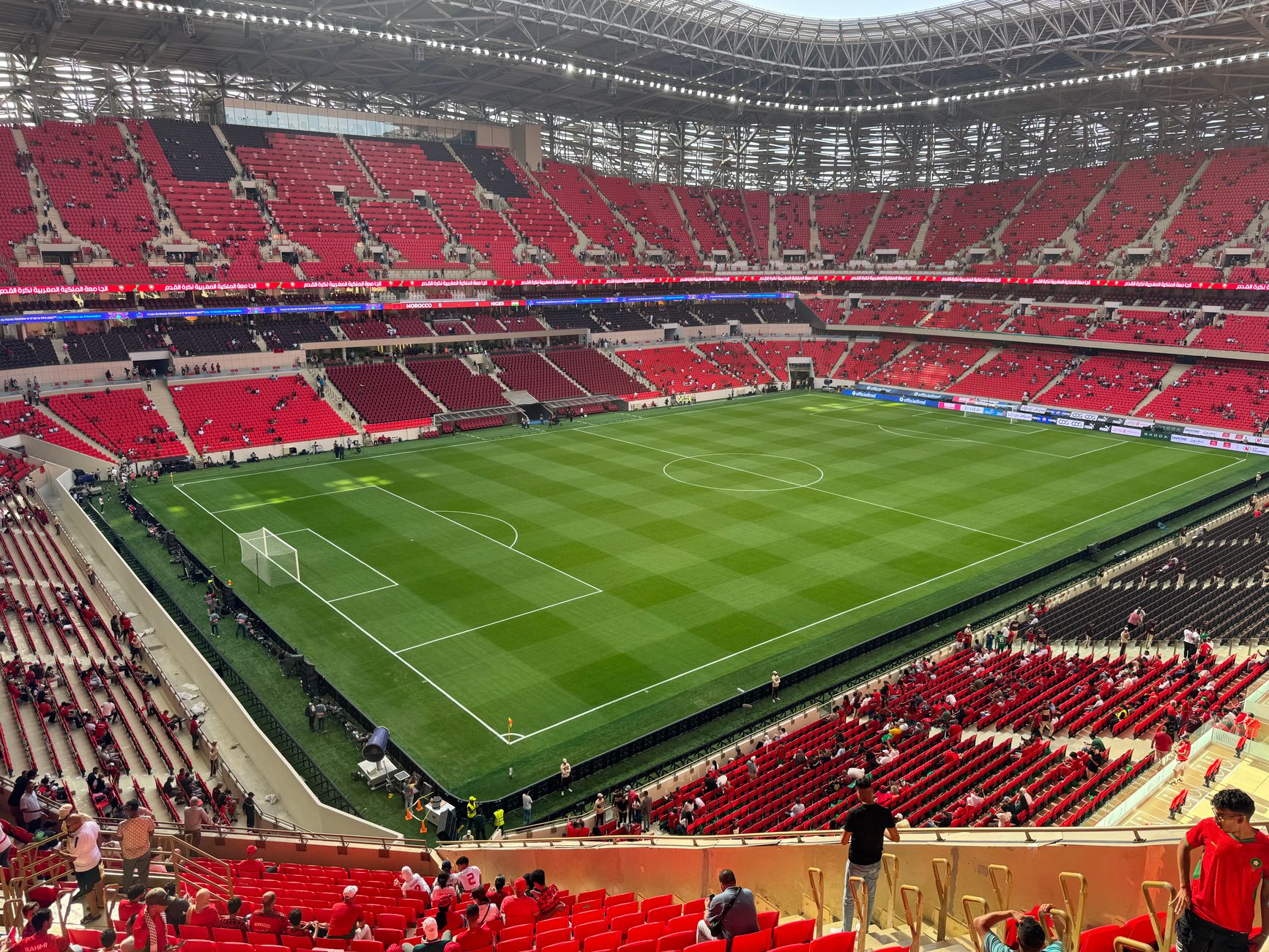
Photo by Earth Photart on Pexels
For readers following the 2026 FIFA World Cup, Tactical Review combines match predictions, tactical analysis, player statistics, and tournament coverage. The useful approach is simple: first establish the team’s structural identity, then measure the current squad, and finally compare those facts with the opponent and the available odds. Sentiment is not a statistic, however much supporters would like it to be.
Want a structured starting point for tournament analysis?
Before 2025: how the Morocco national football team worked
Morocco’s international identity was built through a mixture of North African technique, European tactical influence, and a deep football culture supported by the Royal Moroccan Football Federation. The federation took control of the domestic game after Morocco’s independence in 1956, while the national team gradually established itself as one of Africa’s most technically ambitious sides. Football is Morocco’s most popular sport, with Football in Morocco reporting that approximately 55% of the population declares an active interest in it.
The historic milestones matter because they explain the current expectations:
- Morocco won the Africa Cup of Nations in 1976.
- Morocco qualified for its first FIFA World Cup in 1970.
- The Atlas Lions reached the Round of 16 in 1986, defeating Portugal in the group stage.
- Morocco finished fourth at the 2022 FIFA World Cup.
- Morocco co-hosted the 2025 Africa Cup of Nations and remained central to CAF’s competitive landscape.
- Morocco was selected as a host nation for the 2030 FIFA World Cup alongside Spain and Portugal.
The 1986 team under Mehdi Faria showed that Morocco could compete through possession and technical control. The 2022 side, by contrast, demonstrated how far a Moroccan team could advance through organisation, collective sacrifice, and highly efficient defensive transitions. According to FIFA’s official World Cup coverage, Morocco defeated Belgium, Spain, and Portugal during that campaign, conceding only one goal to an opponent before the semi-final.
The crucial lesson is not merely that Morocco can upset stronger nations. It is that the team’s best tournament results have come when its defensive distances remain short and its wide players attack space immediately after recovery. In practical terms, Morocco do not need 60% possession to control a match; they need control of the dangerous zones. That distinction separates useful analysis from decorative statistics.
What tactical model made Morocco difficult to beat?
Morocco’s strongest tactical model uses a compact mid-block, aggressive protection of the penalty area, and fast transitions through the wings. In the 2022 World Cup, the team often defended with a narrow 4-1-4-1 or 4-3-3 shape before expanding quickly after winning possession. This reduced central passing lanes and forced opponents toward lower-value wide areas.
Regragui’s system generally depends on five repeatable behaviours:
- The centre-backs protect the box before chasing midfield runners.
- The holding midfielder screens the space in front of the defence.
- Full-backs choose attacking moments carefully rather than advancing simultaneously.
- Wingers carry the ball over distance after turnovers.
- The striker occupies defenders even when he does not receive the final pass.
This is why Morocco can appear less dominant on a possession chart while still producing the more dangerous moments. Sofyan Amrabat’s positional discipline was particularly important in 2022, while Romain Saïss provided leadership and aerial strength before injury affected his tournament. At the other end, goalkeeper Yassine Bounou delivered high-value saves and calm distribution.
The model has a weakness, naturally. When opponents refuse to overcommit, Morocco receive fewer transition opportunities. A low block can make the Atlas Lions circulate the ball sideways for long periods, placing more responsibility on Hakim Ziyech, Brahim Díaz, or the full-backs to create a decisive action.
The 2026 shift: what has changed around Morocco?
The 2026 shift is not one single formation change; it is the movement from surprise contender to established target. Morocco’s fourth-place World Cup finish changed opponent preparation, media expectations, and betting-market perception. Teams now understand that giving Morocco open space is dangerous, so many opponents will prioritise rest defence, controlled possession, and protection against counterattacks.
Morocco also face a wider tournament context. The 2026 FIFA World Cup expands to 48 teams, with the United States, Canada, and Mexico hosting matches across a large geographical area. Travel, climate variation, recovery time, and squad depth therefore become more important than they were in Qatar 2022. The FIFA World Cup 2026 official tournament information confirms the expanded format and host arrangement, but match-specific scheduling must still be checked when fixtures are published.
For Morocco, this creates three operational questions:
- Can the team maintain defensive intensity across a longer tournament?
- Can the bench replace key starters without reducing technical quality?
- Can Morocco break down deep opponents when transition space disappears?
The answer should not be guessed from FIFA ranking position alone. Rankings aggregate results; they do not show whether a team creates chances against a low block, whether its first-choice full-backs are available, or whether its midfield can survive a high-pressing opponent.
[Internal Link: 2026 World Cup team tactical rankings]
A useful information-gain point is that Morocco’s 2022 success can distort current prediction models in two opposite ways. Some bettors overvalue the emotional narrative and assume every difficult match will become another historic upset. Others overcorrect and treat the campaign as an unrepeatable accident. The better method is to separate stable features, such as defensive organisation and goalkeeper quality, from variable features, such as finishing, injuries, and opponent game state.
Here is the evidence hierarchy I recommend:
- Confirm the starting goalkeeper and central-defensive pairing.
- Check whether Morocco’s strongest ball carriers start together.
- Compare the opponent’s defensive line with Morocco’s transition speed.
- Review the last five competitive matches, separating home and away performance.
- Only then examine the price and implied probability.
Read the full match context before taking a position.
What changed for players in the Morocco national football team?
The player pool has become more internationally experienced, with important contributors developing in Europe’s major leagues and elite competitions. Achraf Hakimi remains the clearest example: his pace, recovery ability, overlapping runs, and set-piece delivery make him valuable both as a right-back and as an attacking outlet. Noussair Mazraoui offers flexibility across the defensive line, although availability and role must be assessed for each international window.
The attacking group has also evolved. Hakim Ziyech brings left-footed creativity and experience, while Brahim Díaz can operate between the lines or from a wide position. Sofiane Boufal, Youssef En-Nesyri, and other forwards have provided different solutions, but Morocco’s output changes considerably depending on whether the striker can hold the ball and whether the wingers receive possession facing forward.
The core player-monitoring list includes:
- Yassine Bounou: goalkeeper, shot-stopping, command of the penalty area.
- Achraf Hakimi: right-back, transition acceleration, crossing, recovery runs.
- Noussair Mazraoui: defensive versatility and build-up support.
- Sofyan Amrabat: midfield screening and defensive balance.
- Brahim Díaz: chance creation between midfield and defence.
- Hakim Ziyech: left-footed delivery, switches of play, and set pieces.
- Youssef En-Nesyri: penalty-box movement and aerial threat.
- Nayef Aguerd: centre-back positioning and first-pass quality.
Do not make the beginner’s mistake of treating a squad list as a starting XI. Club minutes, travel, injury status, tactical compatibility, and the manager’s latest selection all matter. A famous name who has played 90 minutes twice in six weeks may be less useful than a less celebrated player arriving with rhythm and physical sharpness.
Does Morocco have enough attacking depth for 2026?
Morocco’s attacking depth is promising but should not be described as unlimited. Hakimi, Díaz, Ziyech, and En-Nesyri provide different attacking profiles, yet the team can still struggle when an opponent defends with two compact lines and refuses to give up transition space. The decisive question is whether Morocco can create through combinations, not simply whether it possesses talented forwards.
That is where the next generation matters. Players such as Bilal El Khannouss have offered progressive passing and close control, while Abde Ezzalzouli can provide direct running from wide areas. The balance between established leaders and emerging players will determine whether Morocco can rotate without losing its identity. In tournament football, a substitute who can change the match for 25 minutes may be more valuable than an additional similar starter.
A practical assessment should track four numbers over competitive fixtures:
- Non-penalty expected goals created per 90 minutes.
- Shots allowed from central areas.
- Final-third turnovers leading to shots.
- Set-piece chances created and conceded.
These figures explain more than raw goals alone. For example, a late winning goal may conceal 85 minutes of weak chance creation, while a goalless draw may include repeated high-quality opportunities. [Internal Link: expected-goals guide for World Cup predictions]
The contrarian conclusion is that Morocco’s ceiling may depend less on finding another superstar than on improving the second phase of attacks. When the first counterattack is stopped, the team needs a reliable rest attack: enough players behind the ball to prevent counters, but enough movement around the box to generate a second chance. That tactical balance is difficult, and yes, you should care about it before trusting a short betting price.
What this means now for Morocco’s 2026 World Cup prospects
Morocco should be evaluated as a serious knockout-stage candidate, but not as an automatic semi-finalist. Their defensive base, World Cup experience, and growing player quality create a high floor. However, tournament progress will depend on the draw, opponent profiles, injury timing, finishing variance, and the team’s ability to score first against cautious opposition.
The current assessment can be divided into strengths and risks.
| Category | Morocco’s position | Why it matters |
|---|---|---|
| Defensive organisation | Strong | Compact lines reduce central chances |
| Goalkeeper quality | Strong | Bounou can protect narrow leads |
| Wide transitions | Strong | Hakimi and fast wingers attack space |
| Possession against low blocks | Variable | Circulation can become predictable |
| Squad depth | Improving | Younger players offer rotation options |
| Set pieces | Potential edge | Delivery and aerial defenders create value |
| Finishing reliability | Variable | Tight matches may produce few chances |
| Tournament travel | New challenge | North American distances affect recovery |
A responsible prediction process should also protect your bankroll. This is not because football is mysterious; it is because even a well-priced position loses frequently. If your estimated probability is 58% and the market implies 50%, you have a theoretical edge, not a guaranteed result. Keep a record of the stake, closing price, result, and reasoning. After 20 or 30 selections, you can identify whether your process actually works or whether you merely remember the dramatic wins.

Photo by Lukas Blazek on Pexels
Tactical Review is designed for this type of work: team tactics, player statistics, match predictions, and 2026 tournament developments in one place. Use the information to improve decisions, not to manufacture certainty. If a line-up announcement changes the expected game state, your original opinion is outdated and should be revised.
For deeper preparation, review the [Internal Link: responsible football betting bankroll framework] before placing any wager. The framework should include a fixed unit size, a maximum daily exposure, and a rule against chasing losses. The Royal Moroccan Football Federation, CAF, FIFA, and official club channels remain the best sources for squad announcements; social-media rumours are not evidence.
Three predictions for the next international window
The next international window should be analysed through scenario forecasting rather than a single confident claim. Morocco’s result will depend on the opponent, venue, and line-up, but three broader predictions are defensible from the team’s tactical profile.
1. Morocco will continue to control central defensive zones
Expect Morocco to prioritise compactness in front of the centre-backs, especially against teams with dangerous attacking midfielders. This should limit clear central chances but may concede possession and crosses. The key measurement is not possession percentage; it is the location and quality of the chances conceded.
2. Hakimi’s role will remain a major attacking variable
When Achraf Hakimi overlaps, Morocco gain width, speed, and an additional crossing route. Yet his forward movement also creates space behind him, meaning the holding midfielder and right-sided centre-back must cover intelligently. If an opponent has a rapid left winger, Hakimi’s attacking freedom may be moderated.
3. Low-block matches will decide the market value
Morocco may be most difficult to price against defensive opponents. The public remembers wins over Belgium, Spain, and Portugal, but those matches offered different spaces from a cautious qualifier. If Morocco face a low block, examine line-breaking passes, box entries, set pieces, and substitutes before assuming the favourite’s price is attractive.
The first prediction concerns a stable structural habit. The second depends on personnel and opponent threat. The third is where analytical discipline creates the greatest difference, because popular narratives usually focus on Morocco’s biggest victories rather than its less glamorous games.
[Internal Link: Morocco national team match prediction checklist]
My final recommendation is deliberately less exciting than a bold tournament forecast: wait for confirmed line-ups, compare the tactical matchup, calculate the implied probability, and stake only an amount you can lose without changing your decisions. Morocco are capable of another deep World Cup run, but capability is not probability. Record the evidence, update the estimate, and let the numbers—not nostalgia for Qatar 2022—decide.
See the latest Morocco and 2026 World Cup analysis here.
Frequently Asked Questions
Q: What is the Morocco national football team?
A: The Morocco national football team is the men’s international side representing Morocco and is governed by the Royal Moroccan Football Federation. It competes in CAF tournaments, FIFA World Cup qualification, the Africa Cup of Nations, and international friendlies. The team is commonly called the Atlas Lions and became the first African nation to reach a FIFA World Cup semi-final after its run at Qatar 2022.
Q: How did Morocco reach the 2022 World Cup semi-final?
A: Morocco reached the 2022 FIFA World Cup semi-final by defeating Belgium in the group stage, Spain in a penalty shootout in the Round of 16, and Portugal in the quarter-final. Its success came from compact defending, excellent goalkeeping from Yassine Bounou, disciplined midfield work, and fast counterattacks. France ended the run with a 2–0 semi-final victory, while Croatia defeated Morocco in the third-place match.
Q: What is the difference between Morocco’s 2022 team and its 2026 team?
A: Morocco’s 2022 team relied heavily on defensive cohesion and transition attacks, while the 2026 group is expected to offer greater attacking depth and international experience. Achraf Hakimi, Sofyan Amrabat, and other established players remain important reference points, but younger talents such as Bilal El Khannouss can add creativity. The main challenge is replacing injured or unavailable leaders without weakening the compact defensive structure.
Q: How should I analyse a Morocco national team match prediction?
A: Start by checking the confirmed line-up, then compare Morocco’s transition strengths with the opponent’s defensive approach. Review recent competitive matches, home-and-away splits, expected-goals trends, set-piece performance, and relevant injuries before comparing the bookmaker’s price with your own probability estimate. Avoid treating a famous 2022 result as direct evidence for a different fixture, because opponent style changes the match substantially.
Q: Is Morocco a strong candidate to reach the 2026 World Cup knockout stage?
A: Morocco should be considered a credible knockout-stage candidate, but qualification from the group is not guaranteed. The team has a strong defensive foundation, elite-level players such as Achraf Hakimi, and recent World Cup experience. Its prospects will depend on the draw, schedule, opponent quality, player fitness, and whether it can create goals against deep defensive blocks.
Q: What are Morocco’s biggest tactical weaknesses?
A: Morocco’s main tactical weakness is chance creation when opponents defend in a low, compact block. The Atlas Lions are most dangerous when they can win the ball and attack open space, but that advantage decreases when the opposition keeps many players behind the ball. Analysts should therefore examine second-phase attacks, central box entries, set pieces, and substitute impact rather than relying only on counterattack statistics.
Q: Is it free to follow Morocco analysis on Tactical Review?
A: Tactical Review is a FIFA World Cup-focused content site providing match predictions, tactics, player statistics, and tournament coverage, with availability and access determined by the site’s current terms. Readers should check the website directly for the latest features, regional access, and any account requirements. Gambling-related decisions should be made legally, within personal limits, and never with money needed for essential expenses.
Thank you for reading.
Tactical Review · Strategic Archive